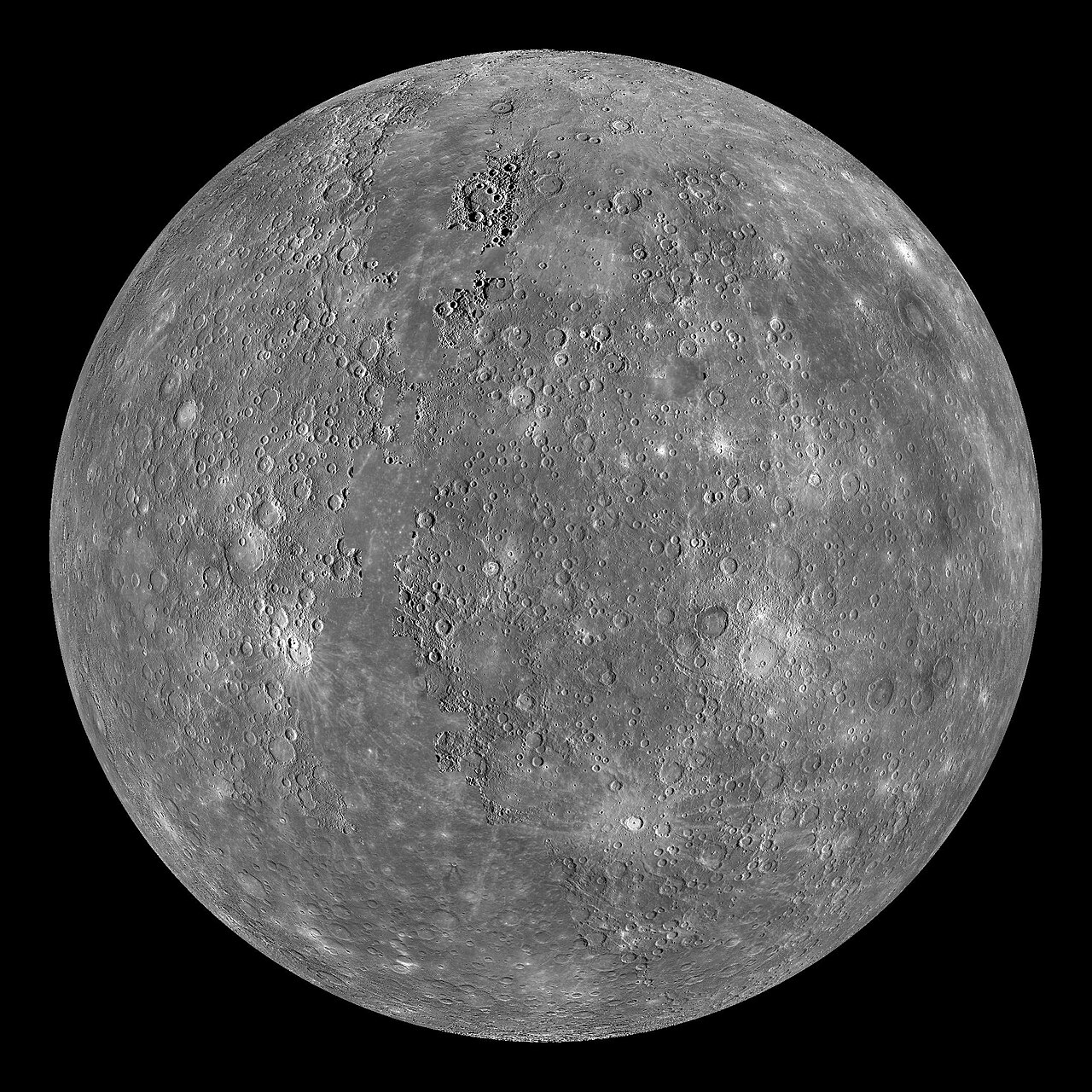
After nearly eight years in space, the BepiColombo mission has arrived at Mercury. The European Space Agency (ESA) confirmed on 21 November that the spacecraft had been captured into orbit around the smallest planet in our solar system, making it only the second mission ever to do so.
What is BepiColombo?
BepiColombo is a joint mission of ESA and the Japan Aerospace Exploration Agency (JAXA) that carries two orbiters to study Mercury.
The European orbiter, the Mercury Planetary Orbiter, will map the planet's surface and study what it is made of. The Japanese orbiter, called Mio, will study Mercury's magnetic field and the space around it. The mission is named after Giuseppe "Bepi" Colombo, an Italian scientist who studied Mercury's motion and helped plan the route of NASA's Mariner 10 mission in the 1970s.
A long road to a small planet
BepiColombo was launched on an Ariane 5 rocket from French Guiana in October 2018. Reaching Mercury is harder than it sounds: a spacecraft falling towards the Sun speeds up, so it must lose a great deal of speed to be captured by such a small planet. To do that, BepiColombo used nine flybys, one of Earth, two of Venus and six of Mercury itself, to adjust its path. AeroTime reported that it travelled around 9.9 billion kilometres on the way. Its arrival was originally expected in late 2025, but a power problem with its electric thrusters, found in 2024, meant the route had to be redesigned.
According to AeroTime, the spacecraft first settled into a stretched, or elliptical, orbit that passes over Mercury's poles, ranging from about 590 to 11,640 kilometres above the surface.
What happens next
Capture is only the start. ESA plans for the two orbiters to separate on 9 and 10 December, after which each will move into its own orbit. The main science work is due to begin in April 2027.
Mercury still holds many puzzles. Scientists want to understand why it has such a large iron core for its size, why it has a magnetic field at all, and how much water ice hides in permanently shadowed craters near its poles, where MESSENGER found strong signs of it. NASA's MESSENGER spacecraft, which orbited Mercury from 2011 to 2015, answered some questions and raised others. With two orbiters working together, BepiColombo is expected to give the most detailed view of the planet yet.
Sources
- AeroTime: BepiColombo reaches Mercury after eight years in space (22 November 2026)
- Manila Times: Japan-Europe joint probe enters Mercury's orbit (22 November 2026)
- Space.com: European-Japanese BepiColombo arrives in orbit around Mercury today (21 November 2026)
- ESA: Latest updates, BepiColombo's arrival at Mercury












Leave a reply