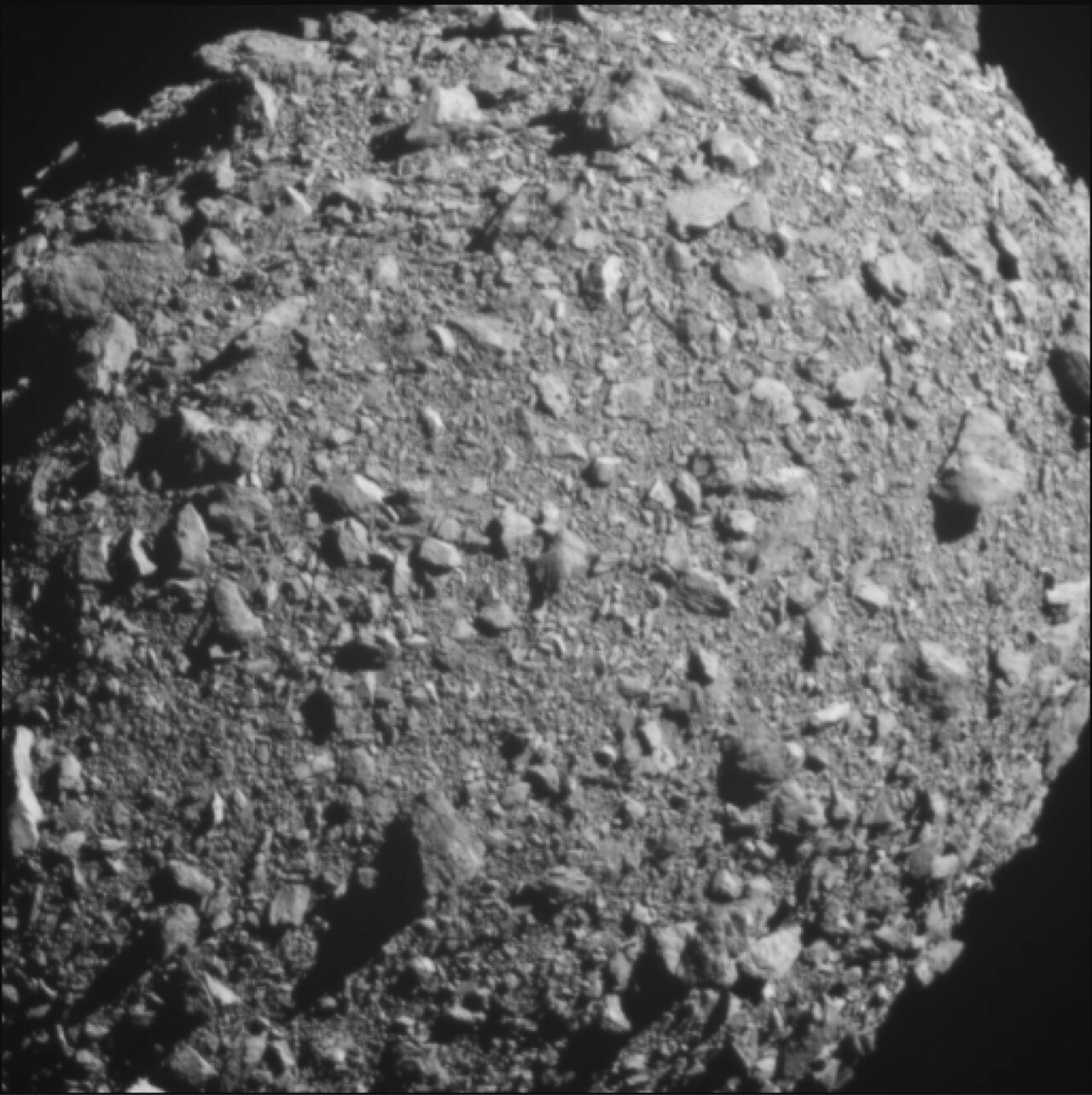
Four years after NASA crashed a spacecraft into an asteroid to see whether it could change its path, Europe has gone back to look at the damage. The European Space Agency's Hera mission released its first close-up images of the asteroid Dimorphos on 25 November, and the scientists say it has turned out to be full of surprises.
What did Hera find on Dimorphos?
Hera found that the side of Dimorphos struck by DART has been flattened into a crater the size of a sports stadium, stretching across the asteroid's whole width, and that the asteroid is now tumbling.
Dimorphos is a small moonlet, about 151 metres across, that circles a larger asteroid called Didymos, about 730 metres across. On 26 September 2022, NASA's DART spacecraft deliberately flew into it. Telescopes on Earth showed that the impact shortened Dimorphos's orbit by about 33 minutes, much more than expected, but nobody could see what had happened to the asteroid itself.
Hera's principal investigator, Patrick Michel of the French research agency CNRS, said scientists had debated whether Dimorphos had gained a crater, changed shape or stayed the same, and that the answer was "all three at once". ESA said the rest of the asteroid looks much as it did in DART's 2022 pictures.
A tumbling moonlet and a swarm of boulders
ESA's Hera mission scientist, Michael Kueppers, said the images showed the impact had left Dimorphos tumbling wildly in its orbit. Long exposures from one of Hera's cameras also revealed hundreds of previously unknown boulders, just a few metres across, orbiting the pair of asteroids. Physics World and ABC News in Australia also reported the crater and the boulders. The team will have to steer around them as Hera moves closer.
The first images were unveiled in the dinosaur hall of the Museum für Naturkunde in Berlin, a reminder of the asteroid that struck Earth 66 million years ago. Hera was launched on 7 October 2024, Space.com reported, and is about the size of a small car.
What happens next
According to ESA, Hera is currently flying about 25 to 30 kilometres from the asteroids. In December it is due to move in to around 13 kilometres for sharper images, and in January 2027 it plans to release two shoebox-sized CubeSats. One, Juventas, led by Luxembourg, will use radar to look inside an asteroid for the first time and will later try to land. The other, Milani, led by Italy, will study the asteroids' surface material and dust.
Together, DART and Hera are the first full test of whether humanity could nudge a dangerous asteroid off course. Dimorphos itself has never been a threat to Earth.
Sources
- ESA: Hera reveals stadium-sized asteroid crater from spacecraft impact (25 November 2026)
- ABC News: New photos reveal stadium-sized crater in Dimorphos asteroid
- Physics World: Close-up images reveal giant DART impact crater on asteroid Dimorphos
- Space.com: Europe unveils first close-up views of asteroid Dimorphos










Leave a reply