Astronomers have broken the record for the most distant quasar ever found. The object, spotted by the European Space Agency's Euclid telescope, is shining from a time when the universe was only about 630 million years old, and it holds a black hole so big that scientists are not yet sure how it grew so fast. The discovery was reported on 24 November.
What is the new record-breaking quasar?
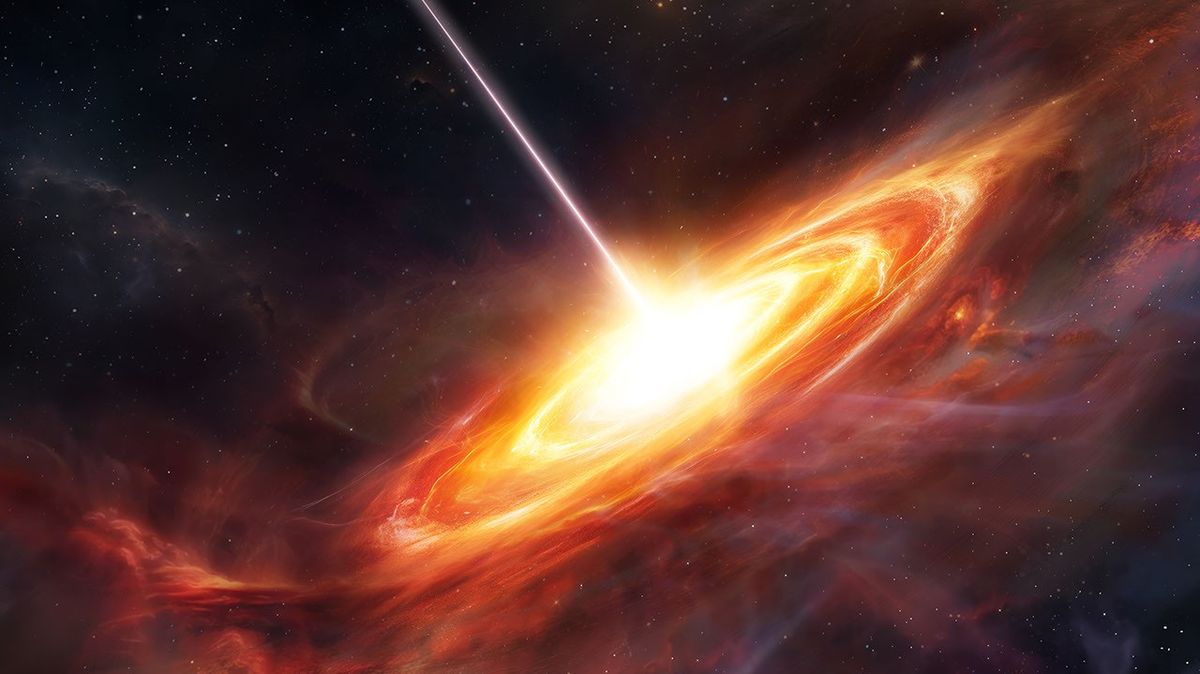
It is a quasar called J1504+6252, nicknamed Dún Aonghasa, whose light set out when the universe was about 630 million years old, making it the most distant quasar known.
A quasar is the brilliant centre of a young galaxy, powered by a supermassive black hole swallowing gas. The material heats up as it falls in and can outshine all the stars in its galaxy. Because light takes time to travel, seeing a very distant quasar means looking back in time: this light left it about 13.1 billion years ago, when the universe was around 5 per cent of its present age.
The results were published in the journal Astronomy and Astrophysics. Astronomers measure distance in this case by "redshift", and Dún Aonghasa has a redshift of 8.13, the first quasar ever confirmed beyond 8, Popular Science reported.
A black hole that grew too fast
The team estimates that the quasar's black hole is about 360 million times the mass of the Sun. That is the puzzle. A black hole of that size should take a long time to build up, and the universe was still very young. Popular Science reported that the black hole seems to be feeding slowly now, so it must have grown in fast bursts early on, which challenges current ideas about how black holes form. The mass is an early estimate, so the true figure could change.
The lead author, Julien Wolf of the European Southern Observatory, told the Associated Press: "This time the leap in cosmic time is huge!" The new quasar is about 40 million years older than the previous record holder, which Euclid also found earlier this year. Observations with the Hubble and James Webb space telescopes helped confirm the result, AP reported.
Named after an Irish cliff fort
Wolf named the quasar after Dún Aonghasa, a prehistoric stone fort on the edge of a cliff on Ireland's Aran Islands. According to AP, his wife and daughter are Irish, and he chose it because the fort stands at a frontier looking out over a vast horizon, much like the quasar at the edge of the known universe.
More records may follow
Euclid launched in 2023 to map billions of galaxies, and it found this quasar among millions of objects in its early data. Wolf told AP that the record could fall again within months or stand for years, and astronomers expect Euclid to find more quasars this far away as its survey continues.
Sources
- Associated Press via Phys.org: Scientists discover quasar formed within 630 million years of the Big Bang (24 November 2026)
- Popular Science: Oldest known quasar formed 630 million years after the big bang
- Associated Press via Yahoo News UK: Scientists discover quasar formed 630 million years after the Big Bang
- Wikipedia: Euclid (spacecraft)










Leave a reply